
Dri-Eaz Water Damage Restoration in Temecula: A Homeowner’s Guide
If you’re searching for “Dri-Eaz water damage restoration Temecula,” you probably already know this: the equipment a restoration company shows up with matters. Dri-Eaz is the benchmark for professional-grade drying, but owning the machines isn’t the same as knowing how to deploy them. This guide walks through what Dri-Eaz equipment actually does, how to verify it’s set up correctly in your home, and why seeing that name on a truck is a meaningful quality signal. If you’d rather skip the research and just get someone out there, call (844) 878-6356 and we’ll walk you through it.
There Are Two Kinds of Dehumidifiers (And Temecula Summers Expose the Difference)
Here’s what most homeowners don’t hear until it’s too late: not every dehumidifier works in August heat. A standard contractor-grade refrigerant dehumidifier starts losing efficiency once indoor air climbs above 85°F. In a closed-up Temecula house after a pipe burst in July, the interior can easily hit 90 – 95°F. The machine runs, the fan spins, but the moisture removal drops to a fraction of its rating.
A Dri-Eaz LGR (low-grain refrigerant) unit is engineered for exactly this scenario. LGR dehumidifiers pull moisture down to much lower levels than conventional refrigerant models, something measured in grains per pound (GPP). Standard units typically stall around 45 – 50 GPP. A Dri-Eaz LGR can drive indoor air down into the 30s, sometimes lower, depending on the model and conditions. That gap doesn’t sound like much on paper. In a real drying scenario, it can add four to six extra days to your timeline, along with higher energy costs and greater risk of secondary damage like warped flooring or microbial growth.
So when a restoration crew in Temecula arrives, glance at the equipment. If they’re pulling out a Dri-Eaz, Phoenix, or XPOWER LGR, that tells you they’ve invested in hardware built for Southern California’s climate, not whatever was cheapest at the rental counter.
What Dri-Eaz Equipment Actually Does in Your Home
Dri-Eaz makes a full ecosystem of drying tools, not just dehumidifiers. Understanding what each piece does helps you ask better questions when a crew is working in your house.
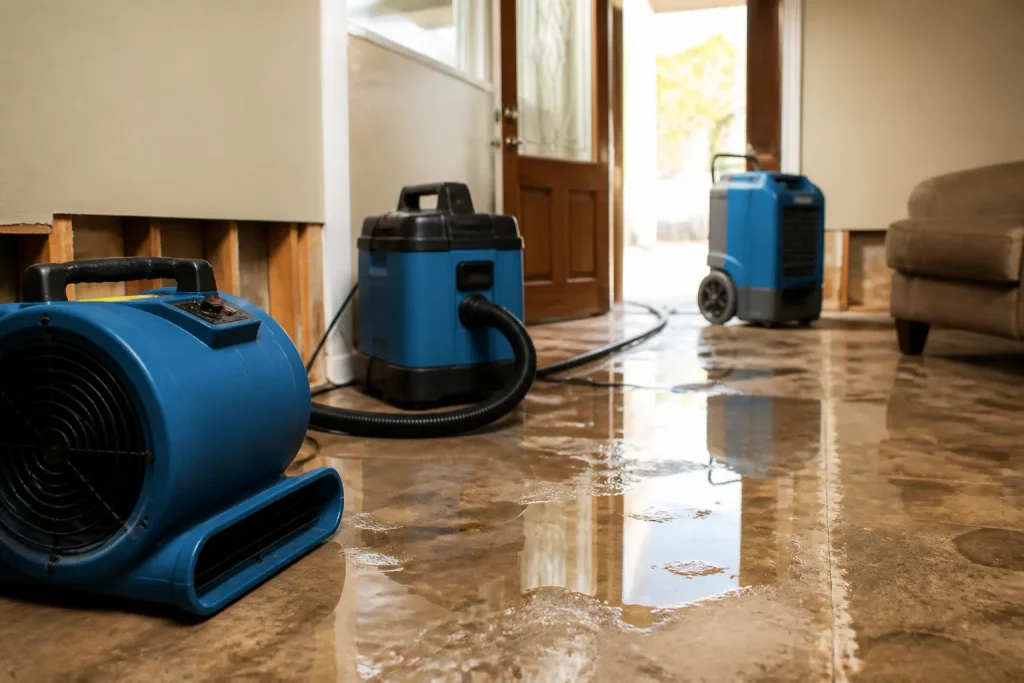
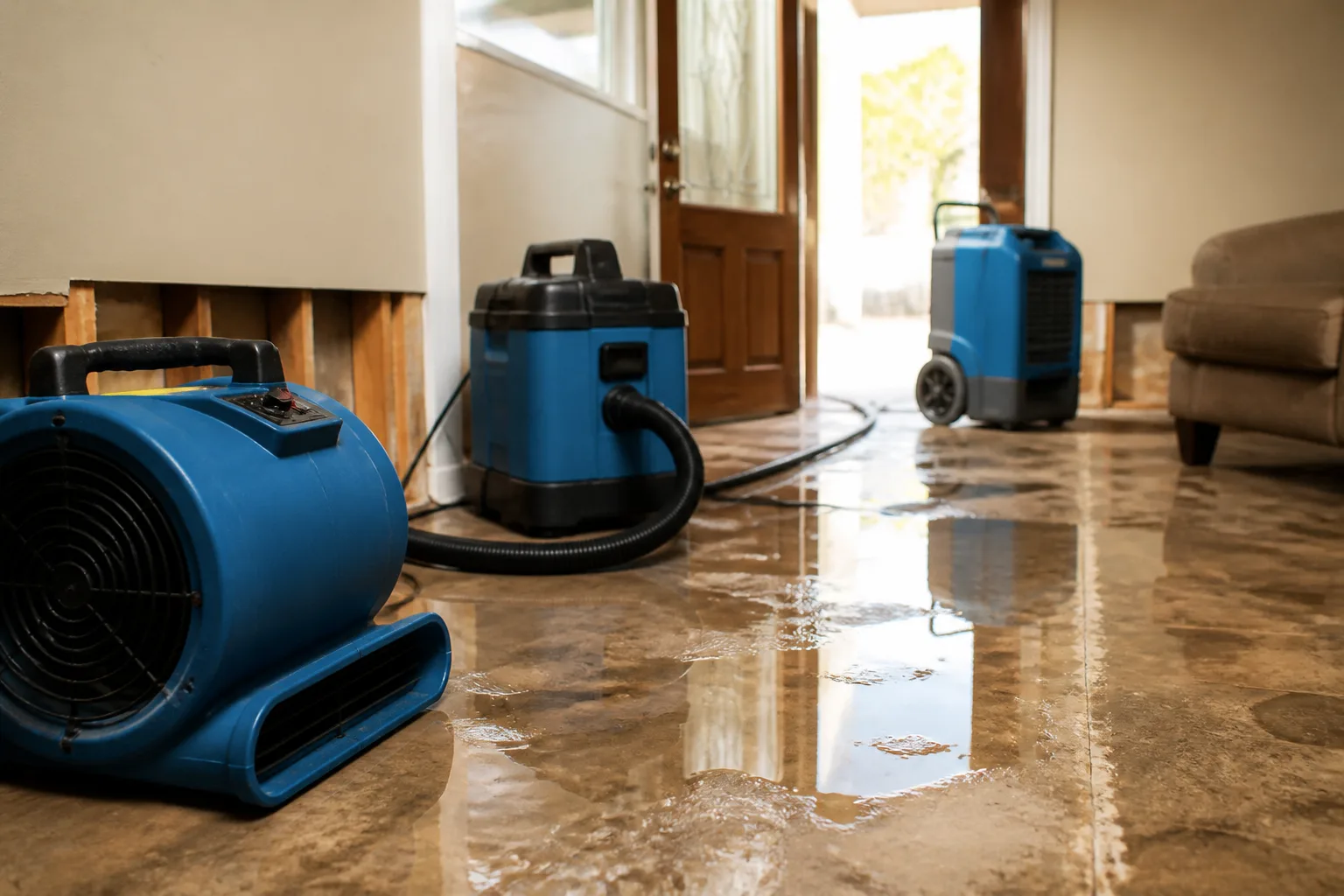
- LGR Dehumidifiers: The workhorse. Pulls water vapor from the air continuously, handles high temperatures without losing efficiency, and gets indoor GPP down to levels that force moisture out of drywall, wood, and concrete.
- Air Movers: High-velocity fans positioned to create airflow across wet surfaces. Air speed accelerates evaporation, and the evaporated moisture gets captured by the LGR.
- Injectidry Systems: Specialty drying panels that force air directly into wall cavities and subfloors without ripping out drywall or flooring. In a Temecula home with water trapped behind baseboards or under tile, this can mean the difference between a $400 drying job and a $15,000 reconstruction.
We’ve pulled Injectidry mats out of kitchens in Murrieta and Temecula where the homeowner thought they were looking at a full cabinet tear-out. The right air pressure inside the cavity dried the substrate in three days, and the cabinets stayed intact. That’s what targeted drying is supposed to look like.
How to Verify Equipment Is Set Up Correctly (Not Just Plugged In)
This is where the difference between owning Dri-Eaz gear and knowing how to deploy it becomes obvious. A dehumidifier running in the middle of an empty room is doing almost nothing for the wet drywall behind the kitchen cabinets. Air movers pointing in random directions waste energy and time. If you’ve got a restoration crew in your Temecula home, here’s what to check.
First, the LGR should be ducted. A Dri-Eaz unit comes with exhaust and intake ducting options. In tight spaces like under-stair closets or small bathrooms, a ducted exhaust pushes dry air into the wet zone while the intake pulls moist air back through the unit. If the machine is just sitting in the hallway with no ducting, ask why.
Second, air movers should be positioned at 45-degree angles to walls, not flat against them. The goal is to create a circular airflow pattern across the wet surface. A fan pointed directly at a wall creates backpressure and actually slows evaporation. The proper setup looks almost intentional, like someone mapped out the air path before plugging anything in. That’s because a qualified technician does map it out, using a psychrometric reading of the room’s temperature, humidity, and dew point to determine equipment count and placement.
Third, there should be a daily moisture log. Dri-Eaz equipment is capable of producing consistent, measurable drying data. Your contractor should check wood moisture content with a penetrating meter, log the readings, and show you the trend. If day two looks identical to day one with no explanation, something is off, either underpowered equipment, wrong placement, or a hidden water source still feeding the problem.
Temecula’s Climate Makes Equipment Choice a Real Decision
Temecula sits in a transitional zone. It’s not desert-dry like Palm Springs, and it’s not coastal-humid like Oceanside, but summer temperatures routinely climb into the 90s and occasionally touch triple digits. That heat changes the math on drying in three ways.
First, warm air holds more moisture, so the absolute humidity load inside a water-damaged room is higher than it would be in, say, Carlsbad. A standard dehumidifier rated at 70 pints per day at 80°F may only remove 30 pints at 92°F. That’s not a manufacturer defect; it’s physics. LGR units are designed for warmer, drier climate performance.
Second, materials dry differently in heat. Hardwood flooring will release moisture rapidly when the surrounding air is hot, but if the dehumidifier can’t keep up, that released moisture lingers in the air and reabsorbs into dry surfaces. You get a cycling effect that stalls progress.
Third, Temecula’s evening temperature swings can create condensation on cool surfaces, especially concrete slabs. A technician who knows the local climate will account for this in their drying plan, often by running equipment at a controlled rate rather than blasting everything full speed.
Ask your contractor this: “What’s the current grain count in my home, and what’s your target?” If they can’t answer, they aren’t doing psychrometry. If they can, you’re probably in good hands.
Dri-Eaz Day 2 vs. Day 4: What the Moisture Log Should Show
Here’s what a healthy drying curve looks like in a Temecula home. Day one: extraction happens, equipment goes in, wood moisture content readings are taken at multiple points. Expect elevated readings, anywhere from 25% to 40% depending on the material and depth of saturation. Day two: you should see a drop of 3 – 5 percentage points in most locations. Day three: another drop, though usually smaller as the material approaches its natural equilibrium. By day four or five, readings should be approaching the normal range for Temecula’s climate, which is typically 8 – 12% for interior wood.
Now, if day two shows no movement, your contractor should be actively investigating why. The three most common causes we see are: a hidden water source still leaking (a supply line behind a wall, a slow slab leak that wasn’t fully addressed), undersized equipment for the cubic footage, or air flow that isn’t reaching the wet surfaces. A stalled reading on day two is never just “needs more time.” It’s a signal to diagnose, not to wait.
This is also why we’re cautious about DIY drying. Renting a Dri-Eaz dehumidifier from a local Temecula equipment supplier is absolutely possible, and for a small, contained water event like a laundry overflow caught within an hour, it can work. But without a moisture meter and some baseline psychrometric knowledge, you’re guessing at progress. You won’t know if equipment placement is optimal, you won’t know when to pull the machines, and you won’t catch a stalled curve until visible signs of damage have already shown up.
Professional deployment means someone is accountable for that curve. That’s the value you’re paying for, not just the machine rental.
DIY Dri-Eaz Rental vs. Professional Restoration: When Each Makes Sense
Let’s be straight about this because we get the budget question all the time. Renting a Dri-Eaz LGR from a local equipment house in Temecula costs around $50 – $80 per day, plus air movers at $20 – $30 each per day. For a two-day dry on a small bathroom leak, that’s maybe $200 – $350 all in. Compare that to professional water damage restoration, which in Temecula typically runs $1,000 – $2,500 depending on the size of the affected area and the equipment hours required. The DIY route is tempting.
Here’s the honest breakdown. DIY rental makes sense when the water is clean (supply line, not sewage), the affected area is small, you caught it immediately, and you can confirm the source is fully stopped. No carpet pad saturation, no wall cavity intrusion, no flooring that’s been exposed for more than a few hours. Under those narrow conditions, running a rented Dri-Eaz for 48 – 72 hours with fans is reasonable.
Professional restoration earns its cost when any of these apply: water traveled into wall cavities or under flooring, the source is uncertain or requires plumbing verification, the water category is gray or black (contaminated), the area is larger than one room, or it’s been more than 24 hours. At that point, you need extraction equipment, containment, psychrometric mapping, and daily monitoring that a rental counter doesn’t come with. You also need someone who knows how to dry wall cavities with Injectidry rather than cutting open perfectly good drywall.
In our experience across Temecula and surrounding areas like Murrieta, French Valley, and Paseo del Sol, homeowners who try to save on the front end with rental equipment on a medium-sized loss often end up paying more later for flooring replacement or mold remediation. The drying curve doesn’t lie, it just takes a few weeks to show you the truth.
How Equipment Choice Signals a Credentialed Operation
Dri-Eaz equipment is expensive. An LGR dehumidifier runs several thousand dollars, and a properly equipped restoration van carries tens of thousands in drying hardware, plus Injectidry systems, moisture meters, and air scrubbers. A company that’s invested at that level has made a financial commitment to doing the job right, because they can’t afford to let that equipment sit idle or get damaged on a poorly run job.
Beyond the hardware, certification matters. The IICRC (Institute of Inspection, Cleaning and Restoration Certification) is the restoration industry’s standard for water damage restoration competency. An IICRC-certified firm has technicians who’ve passed written exams on drying science, moisture measurement, and equipment deployment. That’s the difference between a guy with a wet vac and a professional restoration company that can explain why your grain count is 55 on day one and 38 on day two.
Fresh Start Water Damage operates exactly this way. Our drying fleet runs Dri-Eaz, Phoenix, and XPOWER LGRs alongside Injectidry systems. We’re IICRC-certified, and we maintain membership in the Restoration Industry Association (RIA) and affiliation with the IFA. When you call us, the truck that shows up carries the same class of equipment you’d see on a commercial restoration job in downtown San Diego or Los Angeles, because Temecula homeowners deserve that standard.
The Bottom Line
Dri-Eaz equipment is the industry benchmark for a reason: it performs in the exact conditions Temecula throws at it, from 90°F summer interiors to moisture-laden wall cavities. But machines are only as good as the technician reading the psychrometric data, positioning the air movers, and tracking the daily moisture curve. Ask your restoration company what equipment they run. Ask about LGR vs. standard dehumidifiers. Ask what the grain count was yesterday and what the target is. If they can answer those questions confidently, you’re dealing with a professional operation. If they wave it off, you’re probably not.
We hold ourselves to the dry-smart standard on every job. If you’re in Temecula or the surrounding area and need water damage restoration, mold remediation, or fire damage restoration, call us at (844) 878-6356. We’ll send someone who knows what the equipment does and how to prove it’s working. Learn more about our Temecula water damage restoration here.
Frequently Asked Questions
A typical professional water damage restoration job in Temecula runs between $1,000 and $2,500 depending on the size of the affected area, the equipment hours required, and whether wall cavities or subfloors need targeted drying. Renting a Dri-Eaz LGR unit yourself costs $50 – $80 per day, but you lose the monitoring, extraction, and expertise that prevent secondary damage. For an exact quote, call (844) 878-6356.
Yes, for water damage restoration work. Dri-Eaz LGR dehumidifiers pull moisture down to lower grain counts than standard contractor-grade units and maintain efficiency in high-heat conditions like a Temecula summer. A standard unit loses performance above 85°F, which can extend drying time by days.
For a contained water event with no wall cavity intrusion, a properly deployed Dri-Eaz LGR and air movers can return most rooms to normal moisture levels in 48 – 72 hours. Larger losses, contaminated water, or water trapped under flooring can take five to seven days or more. The daily moisture log should show steady progress, not plateaus.
Yes, for small, clean-water events that you caught immediately and where the affected area is limited. But without a moisture meter and training in psychrometric measurement, you won’t know if the equipment is placed correctly or when to stop. For anything involving wall cavities, under-flooring water, contaminated water, or more than one room, professional drying with certified technicians is worth the cost. Call (844) 878-6356 to talk through your specific situation.
Yes. Our drying fleet runs Dri-Eaz, Phoenix, and XPOWER LGR dehumidifiers, plus Injectidry systems for targeted wall cavity and subfloor drying. We’re IICRC-certified and serve the full Temecula area, including Murrieta, French Valley, and surrounding communities.
If you’re in Temecula and need water damage restoration, mold remediation, or fire damage restoration, visit our home page to learn more about mold remediation in Temecula and fire damage restoration in Temecula. Ready to get started? Call (844) 878-6356 for a free estimate.
Written by the team at Fresh Start Water Damage, serving Temecula since 2017.
Need Damage Restoration Help?
Call Fresh Start Water Damage — licensed & insured, here with fast after-hours help in Temecula.
(844) 878-6356