
Water Damage Restoration What It Really Costs: What Temecula Homeowners Pay in 2026
Most water damage estimates in Temecula land between $2,500 and $8,500 for a typical single-room loss, but identical job scopes can swing from $3,800 to $11,200. The gap isn’t dishonesty. It’s three contractors applying three different IICRC drying standards, billing different equipment days, and treating water categories differently. Here’s what actually drives the number on your invoice.
If you’re standing in water right now and don’t have time for the full breakdown, call Water Damage Restoration in Temecula at (844) 878-6356 and we’ll walk you through it live. Estimates are free.
Why Temecula Water Damage Quotes Vary by 300%
Here’s the scenario we see repeatedly in neighborhoods across Murrieta, Winchester, and Harveston. A homeowner has a Category 2 water loss affecting roughly 400 square feet of engineered hardwood. One contractor quotes $3,800. Another quotes $11,200. Same floor, same water source, same week.
The spread comes down to three things: how many days each contractor plans to run drying equipment, whether they include air scrubbers as standard practice, and whether they’re factoring in the true material makeup of the floor. In Temecula specifically, stucco exteriors change how moisture behaves inside wall cavities. Our summers hover around 90 degrees with single-digit humidity, which actually speeds surface drying but can trap moisture deep in drywall and subfloor if the equipment isn’t staged correctly. A contractor who knows this pattern bills differently than one who doesn’t.
The low quote typically assumes a 3-day dry with two air movers and one dehumidifier. The high quote assumes a 6-day dry with four air movers, two dehumidifiers, and an air scrubber. Neither is wrong on paper. One simply reflects a different standard of care.
Water Categories: The Multiplier Most Quotes Don’t Explain
The IICRC classifies water damage into three categories, and this single variable does more to change your final bill than square footage does. Temecula homeowners often don’t discover which category their loss falls into until a technician tests the water.
Category 1 (clean water): A supply line burst under the kitchen sink, a failed water heater in the garage, an overflowing bathtub. This is the cheapest to remediate. Expect $3.50 to $5.50 per square foot for extraction, drying, and basic materials. Most jobs in this category settle between $2,200 and $4,500 in the Temecula market.
Category 2 (gray water): Washing machine overflow, dishwasher backflow, clean water that sat for more than 24 hours before discovery. This adds antimicrobial treatment and broader material removal. Costs run $5 to $8 per square foot, with most residential claims landing between $4,000 and $9,000.
Category 3 (black water): Sewage backup, flood water from outside, anything containing human waste or pathogens. This is the one that multiplies. Same 400 square feet that costs $3,800 as a Category 1 pipe burst runs $11,000 to $15,000 as a Category 3 sewage loss because contaminated materials require removal under different protocols, disposal fees jump, and full containment is mandatory. In Temecula, Category 3 jobs consistently run 3 to 4 times the cost of comparable Category 1 losses.
- Category 1: $3.50 – $5.50/sq ft, most jobs $2,200 – $4,500
- Category 2: $5 – $8/sq ft, most jobs $4,000 – $9,000
- Category 3: $10 – $15/sq ft, most jobs $11,000 – $15,000
If you’re unsure which category you’re dealing with, don’t guess. A wrong guess on a Category 3 loss can leave contamination behind walls and under flooring. Call (844) 878-6356 and we’ll test it properly.
Equipment Days: The Hidden Line Item Driving Your Invoice
This is where most homeowner confusion lives. Water damage restoration bills are built on something called equipment days: each air mover, dehumidifier, and air scrubber carries a daily rate, and the number of days that equipment runs determines a significant portion of your final cost.
In the Inland Empire market, here’s what we see in 2026:
- Air mover: $35 – $55 per day, each unit
- Commercial dehumidifier (Dri-Eaz or Phoenix): $65 – $95 per day
- Air scrubber: $45 – $75 per day
- Injectidry wall cavity drying system: $85 – $120 per day per cavity
A 400-square-foot hardwood loss needs roughly six air movers and two dehumidifiers to dry in 4 to 5 days. That’s $420 to $540 per day in equipment alone. A 10-day dry at those rates adds $4,200 to $5,400 to your invoice. A 5-day dry adds $2,100 to $2,700. Same floor, same water, nearly double the equipment cost because one contractor monitored moisture levels daily and the other didn’t.
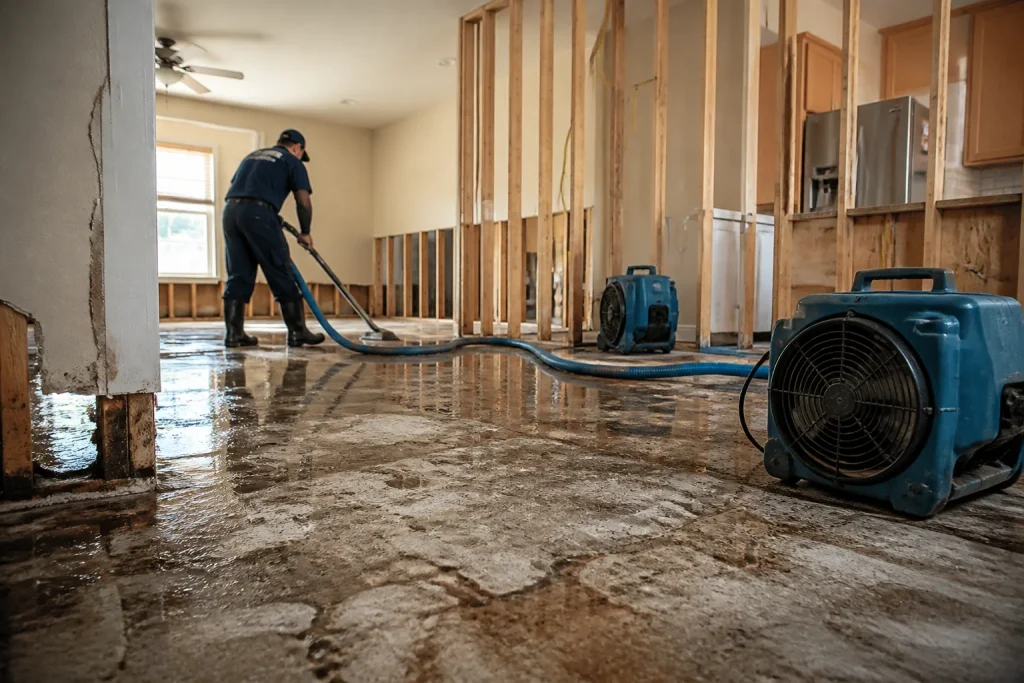
We use commercial-grade drying systems from Dri-Eaz and Phoenix on every job, paired with Injectidry systems for wall cavities and subfloors that would otherwise require demolition. The Injectidry approach matters in Temecula because stucco construction traps moisture between the exterior cladding and interior drywall. Open up those walls and you’re into rebuild territory, which adds thousands. Dry them in place and you preserve the structure. That’s the difference between a $4,000 claim and a $14,000 rebuild.
Temecula-Specific Cost Factors Other Markets Don’t Have
Water damage pricing isn’t uniform across California. Temecula has specific conditions that change costs in measurable ways.
Stucco exteriors change drying strategy. Most Temecula homes built after 1990 use stucco over wood frame. Stucco absorbs and holds moisture differently than vinyl or brick, and when water penetrates a wall cavity, the drying path is restricted. This requires more aggressive staging: more air movers, longer run times, and often Injectidry systems. A contractor quoting based on a 3-day dry may be using assumptions that work in San Diego but fail in Temecula’s construction profile.
Local disposal fees differ from San Diego and Riverside city rates. If contaminated materials need removal, Temecula’s transfer station and landfill fees track differently than neighboring municipalities. We’re not talking hundreds of dollars, but on a Category 3 job with full carpet, pad, and drywall removal, disposal line items can swing $300 to $800 based on where the contractor hauls and what’s classified as contaminated waste.
Home age matters in specific neighborhoods. Homes in older Temecula developments like Paloma del Sol and parts of Meadowview were built with materials and plumbing configurations that respond differently to water. Copper supply lines fail differently than PEX. Cast iron drains crack differently than ABS. These aren’t line items on a quote, but they change how long drying takes, which changes your invoice.
What Your California Homeowner’s Policy Actually Covers in 2026
Here’s the part every Temecula homeowner should understand before the adjuster gets involved: your policy covers sudden and accidental water losses. It does not cover long-term seepage, gradual leaks, or maintenance failures that were discoverable before the loss became catastrophic.
A pipe that bursts while you’re at work on a Tuesday? Covered. A slow leak under the slab that’s been saturating flooring for six months? Almost certainly denied. This distinction has become more aggressively enforced in California since 2023, and Temecula zip codes have not been spared. We’ve watched claim denials spike in 92591 and 92592 specifically around long-term water intrusion cases.
The coverage picture breaks down like this:
- Sudden pipe burst: Typically covered for mitigation and repair, minus deductible
- Water heater failure: Covered if the tank failed suddenly, not if it rusted out over years
- Appliance overflow: Usually covered for the first occurrence; repeat events may trigger maintenance exclusions
- Roof leak from storm damage: Covered if the roof was in reasonable condition; denied if deferred maintenance contributed
- Sewage backup: Only covered if you carry a specific endorsement; most standard policies exclude it
If you’re in the middle of a loss and aren’t sure how your carrier will respond, document everything with photos before any work starts. Then call (844) 878-6356 and we’ll help you understand what you’re looking at, coverage question included. We coordinate directly with adjusters and provide photo documentation throughout the drying process.
The Real Cost of Waiting: 24 Hours vs. 72 Hours
Here’s the number that should make every Temecula homeowner move fast. The difference between responding to a water loss within 24 hours versus waiting 72 hours is not a linear difference. It’s a category change.
Within 24 hours, most clean water is still clean water. Materials are saturated but salvageable. Drywall is wet but intact. Hardwood is swelling but hasn’t cupped permanently. A loss that costs $3,500 to remediate at hour 24 looks very different at hour 72.
At 72 hours, mold colonization has begun. This isn’t a scare tactic; it’s the documented timeline for spore germination in the presence of moisture and organic material. Once microbial growth starts, your claim changes. Mold remediation protocols add $2,000 to $8,000 to most residential claims on top of the water damage costs. That’s the quantifiable cost of waiting.
- 24-hour response: Mitigation only, most jobs $2,500 – $5,000
- 48-hour response: Mitigation plus antimicrobial treatment, most jobs $3,500 – $7,000
- 72-hour response: Mitigation plus mold remediation protocol, most jobs $5,500 – $13,000
We pulled one out of a garage over in Harveston last week where a water heater had been leaking for four days before the homeowner noticed. What would have been a $2,800 extraction and dry job became a $9,400 mold and mitigation project because the sheetrock had been wicking moisture the entire time. The water heater itself was the cheapest part of the whole mess.
The Bottom Line
Water damage restoration costs in Temecula range from about $2,200 for a small Category 1 loss caught early to $15,000 or more for a Category 3 sewage backup. The variables that matter most are water category, equipment days, and response speed. Quotes vary by 300% because contractors apply different standards to those variables. When you’re comparing estimates, don’t just look at the bottom line. Ask how many equipment days are included, which category they’re treating the water as, and whether they stage for Temecula’s stucco construction.
If you’re in Temecula and need help sorting through your options, Fresh Start Water Damage offers free estimates. Call (844) 878-6356 and we’ll give you a real plan, not just a mop and a fan.
Frequently Asked Questions
Most Temecula water damage jobs cost between $2,500 and $8,500, with small Category 1 losses starting around $2,200 and Category 3 sewage backups running $11,000 to $15,000 for the same square footage. The final number depends on water category, affected square footage, and how many days drying equipment runs.
California homeowner’s policies cover sudden and accidental losses like a burst pipe or appliance overflow. They typically deny long-term seepage, gradual leaks, and sewage backups unless you carry a specific endorsement. Document the damage with photos before any work starts, and call (844) 878-6356 if you need help understanding your coverage.
Within 24 hours if possible. After 48 hours, antimicrobial treatment becomes necessary. After 72 hours, mold protocols typically add $2,000 to $8,000 to your total project cost. The faster you respond, the cheaper the claim and the more materials you save.
Contractors apply different IICRC drying standards, bill different equipment day counts, and treat water categories differently. One quote may assume a 3-day dry with minimal equipment while another assumes 6 days with air scrubbers and Injectidry systems. The higher quote isn’t necessarily padding; it may reflect a more complete drying standard.
Is Mold Remediation in Temecula part of water damage restoration?
Not always, but it becomes part of the scope if water sits for more than 72 hours and microbial growth begins. When that happens, mold remediation protocols are required and add significant cost. If you suspect mold after a water loss, call (844) 878-6356 for a proper assessment before it spreads.
Related services: If your water loss involves fire or smoke damage, see Fire Damage Restoration in Temecula. And for more about how we approach water damage specifically, visit Fresh Start Water Damage home.
Written by the team at Fresh Start Water Damage, serving Temecula since 2017.
Need Damage Restoration Help?
Call Fresh Start Water Damage — licensed & insured, here with fast after-hours help in Temecula.
(844) 878-6356