
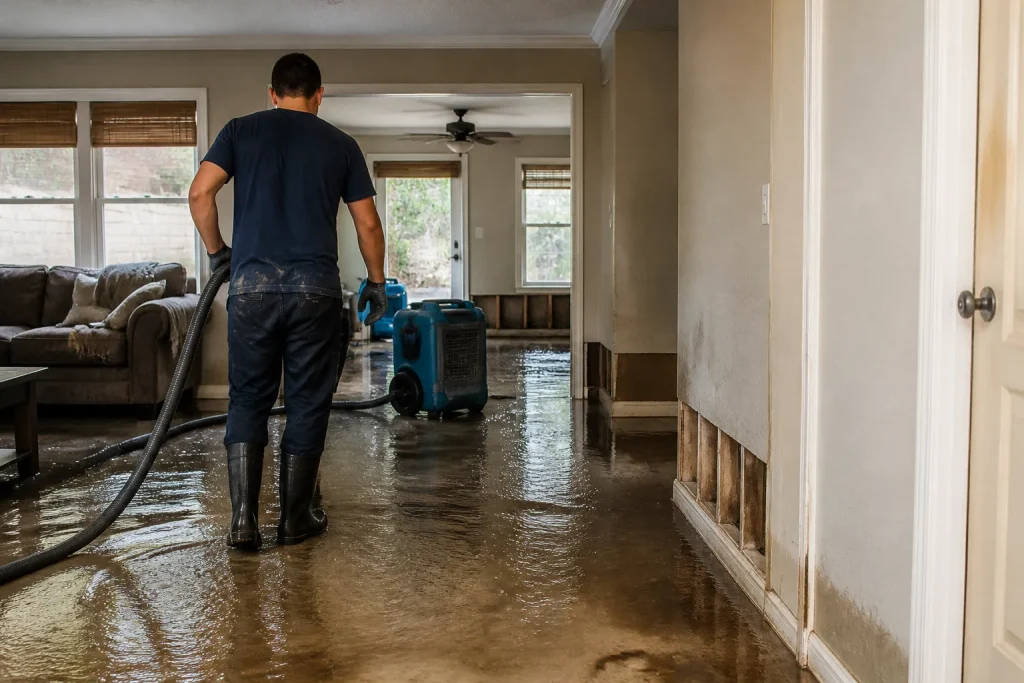
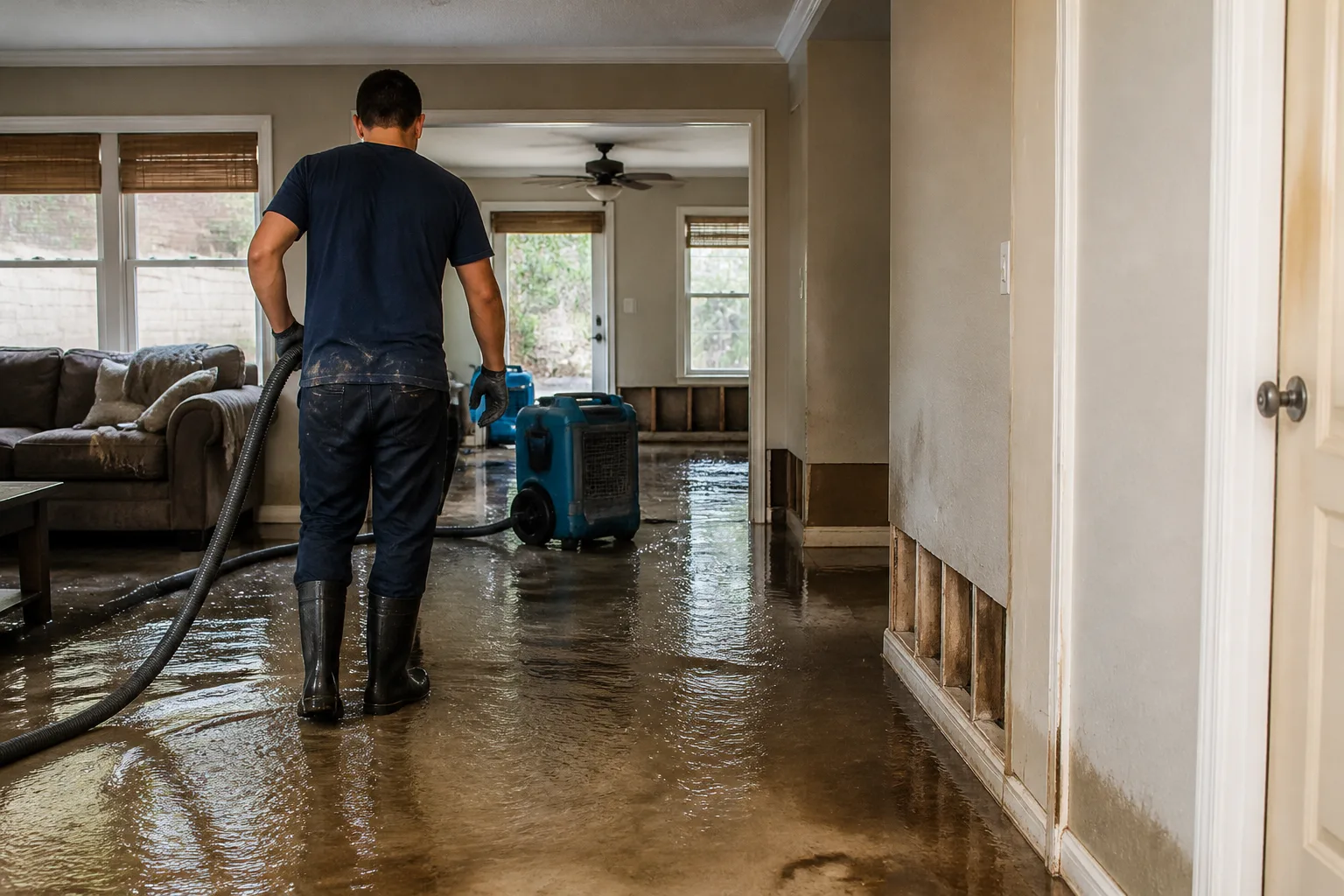
Emergency Water Damage Restoration Near Me: What Temecula Homeowners Should Do First
If you’ve just discovered water pooling in your Temecula home, the single most important move is shutting off the water at the source, then cutting power to the affected area only if you can reach the breaker without standing in water. From there, photograph everything, start extracting with whatever you have on hand, and call a certified restoration crew. If you’d rather not handle the first hour alone, call us at (844) 878-6356 and we’ll walk you through it while a truck rolls your way.
The First 60 Minutes Matter More Than Day Two
Turning off the water supply stops the source, but if you also run your bathroom exhaust fans trying to help dry the space, you’ve just pressurized moisture toward your wall cavities. That’s one of the most common well-intentioned moves we see in Temecula homes, and it quietly increases final restoration costs because it drives water exactly where it should not go: inside walls, behind baseboards, into insulation.
Here’s the sequence that actually works, and it’s a decision tree, not a panic checklist:
- Stop the source. If it’s a supply line break, shut the fixture valve first. If you can’t find it or the leak is behind an appliance, go to your main shutoff.
- Electrical check. If water has reached outlets, or the ceiling below is sagging, cut power at the breaker panel. Never enter standing water in a room with live electricity. When in doubt, wait for a professional.
- Photograph before you move anything. This step matters more than most homeowners realize. Insurance adjusters and restoration crews both need to see exactly what the water touched before anyone starts hauling furniture around.
- Extract what’s safe to move. Saturated rugs can be pulled out and hung. Wet throw pillows, blankets, and floor mats can go outside. What should not be touched: wet drywall, wall cavities, or anything that requires pulling materials apart. That’s how you spread contamination and turn a clean-water event into a mold problem.
- Call dispatch. Have three details ready. We’ll cover exactly what to say below.
We’ve walked into Temecula homes where the homeowner did everything right in the first hour and saved themselves thousands. We’ve also walked into ones where a homeowner spent two hours vacuuming with a shop vac and never called anyone, and the drywall was already wicking moisture into the studs by the time we arrived. The first hour really does set the ceiling on how much damage you’re dealing with.
Where Temecula Tract Homes Hide Their Main Water Shutoff
Most homes in Redhawk, Wolf Creek, and Harveston were built within the last twenty-five years, which means the main water shutoff is a ball valve, not a gate valve. That’s good news because ball valves close with a quarter turn and rarely seize. The challenge is finding it.
In Redhawk, most main shutoffs sit in a ground-level utility box near the water meter, which is typically along the front of the property where the driveway meets the landscape strip. In Wolf Creek, you’ll often find the shutoff inside the garage, on the wall shared with the water heater, about knee height. Harveston homes vary, but many have the shutoff in the side yard behind a small plastic or concrete access cover, usually within six feet of the side gate.
Here’s the part that catches people off guard: if you live in a two-story home built after 2000, shutting the main at the meter or wall may not immediately stop water already inside the walls from above. That water needs to drain somewhere, and it will drain toward the lowest point: your ceiling, your baseboards, your subfloor. Shutting the source is still the right move. It just doesn’t mean the event is over.
If you open the main shutoff and hear a hissing sound gone quiet, you’ve done the job. From there, move to electrical and photos. And if you are not certain you’ve found the right valve, call us before you start turning things randomly. We can guide you over the phone.
Which Rooms Get Attention First, Based on Flooring Type
Not every wet surface is created equal, and in Temecula’s dry climate, homeowners sometimes assume evaporation will handle things and go to bed. That’s a mistake, because Travertine, tile, hardwood, laminate, and carpet all respond to water on very different timelines.
Here’s the triage order we use:
- Hardwood floors: highest priority. In Temecula’s summer heat, hardwood can start cupping and buckling within 2 to 4 hours after water exposure. Once boards cup, they rarely return to flat without sanding and refinishing, or worse, replacement.
- Laminated flooring: urgent but deceptive. Laminate looks fine for the first several hours, then the locking seams swell abruptly. By the time you see it, the panels are scrap.
- Carpet over padding: sneaky slow burn. Carpet itself can handle water somewhat gracefully, but the padding underneath acts like a sponge that never wrings itself out. We regularly pull carpet in Temecula homes where the top layer looks salvagable but the padding is saturated with the kind of water that was clean when it leaked and now is starting to develop an odor.
- Tile over concrete slab: slowest to absorb. Tile and grout resist water penetration more than any other common flooring, but water still travels through grout lines and under the tile over many hours. In a single-story Temecula home on a slab, we often find water has migrated well beyond the obvious wet zone.
One more thing worth knowing: Temecula’s typical summer interior humidity is low, but interior air conditioning creates cool surfaces that condense moisture. What this means for you in an emergency is that a room with the AC blowing can actually slow down evaporation of structural water because cool surfaces don’t dry as fast. Setting your AC to a moderate temperature, not off and not arctic, is the sweet spot.
What to Tell the 24/7 Dispatcher When You Call
When you call a restoration company at 2 a.m., the dispatcher is trying to answer one question: how serious is this, and what equipment will the crew need on the truck. The more precise you can be with three simple pieces of information, the faster the right gear gets staged for your home.
Here is what actually matters:
- Water category. Clean water from a supply line or appliance? Category 1. Water that touched the ground, a drain, or the water heater pan? Likely Category 2. Sewage or toilet overflow? Category 3. This one label changes everything: containment protocols, personal protective equipment, what can be dried versus what must be removed.
- Affected square footage, approximated. You don’t need a tape measure. “Tile kitchen and eating area, maybe 300 square feet, plus water running into the hallway toward two bedrooms” is perfectly useful. This tells dispatch how many air movers, dehumidifiers, and what size of extraction unit to load.
- Flooring type. Hardwood, carpet, tile, laminate. We need to know if we’re pulling padding or drying in place. It changes both equipment and arrival crew size.
Everything else, the dispatcher can clarify with follow-up questions. Those three points are the ones that actually determine response priority. A call that starts with “I have clean water from a broken supply line, about 400 square feet of hardwood and carpet in the living room and hall” gets a completely different truck than a call that starts with “there’s water everywhere and I don’t know where it’s coming from.”
Insurance Calls: When to Make Them, and When They’ll Slow You Down
Here’s a hard truth we see in Temecula regularly: calling your insurance company before calling a restoration company in a true emergency can cost you 4 to 6 hours of drying time. That’s not an exaggeration. Insurance hotlines, even the good ones, route you through intake, then assign an adjuster, then the adjuster calls you back, then you schedule a visit. Meanwhile your hardwood is buckling and that Category 1 water is aging into something less friendly.
The correct sequence is this:
- Call the restoration company first. Even if you haven’t spoken with insurance yet, a certified crew can start mitigation immediately. We photograph everything, document the water category, map the affected areas, and write down what we see before anything is moved. That documentation is exactly what your adjuster will want later.
- Call your insurance company second. While the restoration crew is already working, you make that call. You’ll be able to tell the adjuster precisely what’s happening because a professional team is already on site.
- Keep both parties informed. The restoration crew should know you’re filing a claim. The adjuster should know a certified restoration company is already mitigating. This is not a conflict. It’s coordination, and it’s what insurance professionals expect.
We’ve never had an adjuster penalize a homeowner for mitigating quickly. What they care about is documentation, and professional restoration crews are trained to document exactly what insurance needs. Waiting on an adjuster before anyone starts pulling water is the most expensive phone call you can make in a damage event.
When to Call a Pro
There’s a line between what a homeowner can reasonably handle in the first few hours and what requires training and equipment. It’s usually drawn at the point where water has entered building materials rather than just sitting on top of them.
Call a pro when any of these are true:
- Water has reached or gone under baseboards, walls, or cabinetry.
- The ceiling below the leak is sagging, stained, or dripping.
- You smell anything musty or sewage-adjacent.
- The water event involves an appliance with a drain line, like a dishwasher, washing machine, or water heater.
- Water has migrated into a room with a different flooring type, suggesting it traveled through a wall or under a threshold.
A shop vac is not a restoration tool. It’s useful in the first fifteen minutes to keep water from spreading further, and we’ll never tell someone not to use what they have on hand. But extracting water from carpet padding, drying wall cavities, and measuring moisture content inside structural materials is where certified training and professional equipment take over.
A note on related services: once water sits for more than 48 hours, mold becomes a real possibility, and Temecula’s warm summers accelerate that timeline. If you’ve had a hidden leak or a previous water event that was never properly dried, you may need Mold Remediation in Temecula in addition to water mitigation. We also handle Fire Damage Restoration in Temecula, because fire suppression water causes secondary damage that follows the same drying protocols. And for a full picture of what our team does, start with Water Damage Restoration in Temecula.
Our approach is simple: certified by IICRC, commercial-grade equipment from Dri-Eaz, Phoenix, XPOWER, and B-Air, and Injectidry systems on every applicable job because drying wall cavities without unnecessary demolition is almost always cheaper than torn-out drywall and full rebuild. We dry smarter, not just faster. One team, full restoration.
The Bottom Line
Water damage is a clock, not a static event. Shut the source, kill the power where it’s safe to do so, photograph the scene, move what’s safe to move, and call a certified Temecula restoration crew before you call your insurance company. The sequence matters, and getting it wrong costs real money in the form of additional demolition, mold remediation, and flooring replacement.
If you’re in Temecula and standing in water right now, stop reading and call us at (844) 878-6356. We’ll walk you through your first moves on the phone, and we’ll send a certified crew with commercial-grade equipment. The estimate is free. The peace of mind that comes from knowing a real plan is in motion, not just a mop and a fan, is worth the call.
Frequently Asked Questions
In most cases, a local Temecula restoration company can have a crew on site within a few hours of your call, and many take emergency calls around the clock. The key is to call as soon as you’ve stopped the water source and addressed electrical safety, because every hour of delay adds drying time and costs. Call (844) 878-6356 to find out current availability, and have your water category and flooring type ready when you do.
Most homeowner policies cover sudden and accidental water damage, like a burst supply line or appliance overflow. They typically do not cover gradual leaks that could have been prevented by maintenance. The most important thing for coverage is documentation, which is why photographing the scene before anything is moved matters, and why calling a restoration company before your insurance company is often the smart play.
If water stayed on top of flooring and never reached walls or baseboards, you may be able to dry it yourself with aggressive ventilation and a real dehumidifier. If water touched drywall, soaked into padding, or traveled between rooms, fans alone almost always leave behind enough moisture to trigger mold and odor. Temecula’s climate speeds up the mold timeline, so if you’re not sure, an inspection costs nothing and gives you a straight answer.
Mitigation is the emergency work: extraction, water removal, and setting up professional drying equipment to stop ongoing damage. Restoration is the longer process of returning your home to its pre-loss condition, which may include repairs, material replacement, and refinishing. A certified company handles both phases, and starting mitigation quickly is what keeps the eventual restoration scope as small as possible. If you’re in Temecula, call us at (844) 878-6356 and we’ll tell you exactly which phase you’re in.
Written by the team at Fresh Start Water Damage, serving Temecula since 2017.
Need Damage Restoration Help?
Call Fresh Start Water Damage — licensed & insured, here with fast after-hours help in Temecula.
(844) 878-6356