How to Choose the Right Damage Restoration Company in Temecula
Choosing a damage restoration company in Temecula comes down to three technical questions most homeowners never think to ask: which IICRC certifications does the crew hold for your specific damage type, what equipment will they deploy by make and model, and how do they document the job for your insurer. Google reviews and response time don’t answer any of those questions, and they’re the only ones that predict whether hidden moisture gets left behind or your claim gets denied. If you’d rather not spend the next hour reading, call (844) 878-6356 for a free estimate and we’ll walk you through it.
Here’s the thing we see constantly in this trade: a homeowner has water damage, finds a company with 4.9 stars and 300 reviews, and hires them on a Tuesday morning because they answered the phone first. Three weeks later the baseboards feel spongy, there’s a musty smell, and the insurance adjuster is asking for moisture logs that were never created. The company did what their certification allowed them to do, which wasn’t enough for the actual job.
The IICRC Certification Question: There Are 14 of Them, and One Is Not Enough
IICRC certification is the minimum bar in restoration, not a differentiator. But here’s what most homeowners in Temecula don’t know: the IICRC issues 14 distinct certifications, and a company certified only in water damage that also offers you mold remediation is operating outside their documented competency. Their Google rating doesn’t change that fact.
Here’s how to match the credential to the damage you actually have:
- WRT (Water Damage Restoration Technician) – Covers the basics of extracting water, setting up drying equipment, and monitoring the process. This is the entry point. If a company’s only certification is WRT, they’re qualified for clean-water losses like a burst supply line or an overflowing sink.
- ASD (Applied Structural Drying) – A more advanced credential that covers drying complex structural cavities, hardwood floors, and multi-room water events. If you have water that traveled under walls or into a second floor, you want ASD on the crew.
- AMRT (Applied Microbial Remediation Technician) – Covers mold and sewage contamination. If there’s any chance of microbial growth or a category 3 water loss, you need this on the team. Companies without AMRT who pitch mold work are a red flag.
- FSRT (Fire and Smoke Restoration Technician) – Covers fire damage, soot behavior, and odor removal. If you’ve had a kitchen fire or electrical fire, ask for FSRT explicitly.
This matters because the work changes based on the certification. A WRT-only company can extract water and run fans. But if that water sat for 48 hours behind drywall in a Temecula summer where the garage hits 95 degrees, you now have a mold situation forming, and a WRT-only company doesn’t have the documented training to properly assess or remediate it. We carry the full certification stack at Fresh Start Water Damage because water damage restoration in Temecula rarely stays water damage for long in this heat.
The Equipment Question: Ask for Make and Model Before You Sign
There’s a difference between a restoration company and a guy with a carpet fan and a wet-dry vac. Both will tell you they’re “drying the structure.” Only one can prove it.
Here’s the specific question to ask before you sign anything: “What dehumidifiers and air movers will you deploy, and what’s the total CFM for my square footage?”
A qualified company answers immediately. Here’s why the answer matters:
- Desiccant vs. refrigerant dehumidifiers – Refrigerant dehumidifiers work well in warm, humid air. Temecula’s dry heat means a competent company adjusts its equipment selection accordingly. Desiccant units pull more moisture in cooler conditions. If the tech can’t explain which they’re using and why, that’s a knowledge gap, not just a logistics detail.
- Total CFM of air movement – Professional restoration uses a calculation based on affected square footage and class of water loss. If a company shows up with three box fans for a 1,200-square-foot water event, they’re guessing. The industry standard for structural drying is measurable and specific.
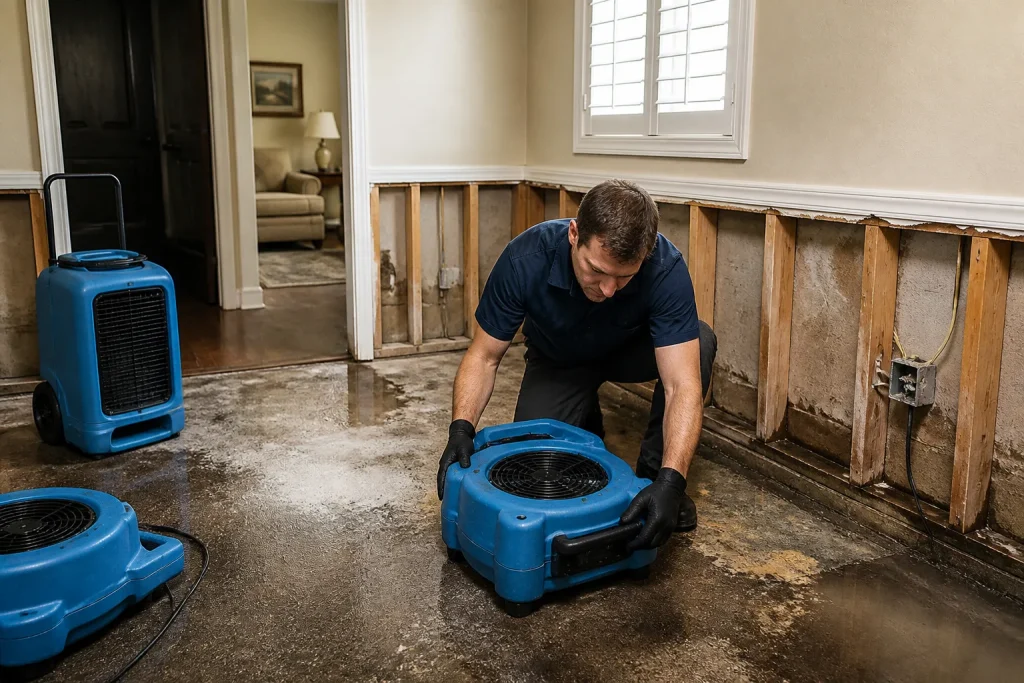
- Brand names matter – Companies serious about restoration run Dri-Eaz, Phoenix, XPOWER, or B-Air units. These are commercial-grade systems designed for structural drying, not consumer rentals from the hardware store down in Temecula. Ask the name of what’s going in your house.
We run those exact brands on every job, plus Injectidry systems when walls are wet but the drywall can be saved. Injectidry pushes controlled airflow into wall cavities and under subfloors without ripping out drywall, which means less demolition, less dust in your house, and a smaller rebuild bill. It’s the difference between drying smarter and just setting up fans and hoping. If a company has never mentioned Injectidry or a similar targeted-drying system, they’re probably doing demo-and-replace instead of drying first, and that costs you money.
The Multi-Damage Problem: Why Coordination Handoffs Create Insurance Gaps
Water damage rarely shows up alone in Temecula. A burst pipe soaks the drywall, and 72 hours later you’re looking at mold behind the baseboard. A kitchen fire gets put out by the sprinkler system, so now you have fire damage and water damage in the same room.
When two different companies handle those problems, the documentation passes through a handoff. Company A does the water extraction and sets up drying. Company B shows up three days later for the mold assessment. The insurance adjuster wants to know: when did the moisture reading spike? Who was monitoring daily? Why wasn’t mold protocol triggered earlier?
Those handoff gaps are where claims get denied. The adjuster isn’t trying to deny you, but they have to verify that a single, consistent standard of care was applied from day one to day twelve. When one company hands off to another, the paperwork has a seam, and seams become excuses.
This is the single-contractor advantage. One certified team managing the full arc means one moisture log, one set of daily readings, one person answering the adjuster’s question about why the drying curve looks like it does. At Fresh Start Water Damage, we handle mold remediation in Temecula and fire damage restoration in Temecula under the same roof as our water work, with certifications across all three. You call one number. One team does the work. One file goes to your insurer. That’s the coordination advantage in practical terms.
The Temecula-Specific Red Flag: Volume Companies and Overflow Territory
Here’s a local issue we’ve watched play out over years of storm seasons here. Temecula sits between two major markets: San Diego to the south and the Riverside/San Bernardino corridor to the north. When a strong storm system rolls through in January or February, companies based in those larger markets get overwhelmed with calls. Temecula becomes overflow territory.
What that looks like on the ground: a crew dispatched from San Diego arrives, sets up equipment, and then gets pulled back to San Diego because a bigger job came in. Your drying equipment sits unmonitored. Moisture readings don’t get logged daily because nobody’s local to log them. The company’s Google reviews are great, because they do great work in San Diego. You’re just not in San Diego.
Questions that expose this pattern quickly:
- “Where is your nearest equipment warehouse to my address in Temecula?” – If the answer is a 45-minute drive, expect less responsiveness.
- “Who does the daily moisture monitoring, and are they based locally?” – If the monitor is a different crew than the install crew, that’s a handoff point.
- “How many active jobs do you have in the Temecula valley right now?” – A qualified local company can answer this. A volume operator avoids it.
You want a company that treats Temecula as home base, not overflow territory. That’s the whole reason we’re here. And it’s why we can run Injectidry on a house off Rancho California Road on a Tuesday and have someone back there Wednesday morning if a sensor shows the drying curve plateauing.
How to Read a Restoration Contract: The Four Clauses That Protect You
Restoration contracts are dense documents written by lawyers and signed by stressed homeowners at 10 p.m. while water is still pooling in the hallway. But there are four clauses that separate a professional operation from a volume operator, and if they’re absent, that absence tells you everything.
1. Daily moisture log delivery. The contract should state that you receive a daily log of moisture readings, which rooms were measured, humidity levels, and what adjustments were made. If this isn’t in writing, you’re relying on the crew’s word. Moisture logs are also the primary document your insurer uses to verify the drying was done correctly. No logs, no verification, no claim.
2. Equipment pull criteria in writing. “We remove the equipment when the job is done” is not a criteria. A professional contract states the specific moisture content threshold (in wood moisture equivalent, usually) that triggers equipment removal, based on the dry standard for unaffected materials in your home. Without this, equipment might come out too early because the company needs the machines for another job, leaving hidden moisture behind.
3. Mold protocol trigger threshold. If moisture readings hit a certain threshold or if visible microbial growth is discovered during drying, what happens? A professional contract says: we stop, we assess under AMRT protocols, we document, and we adjust the scope. An absence of this clause means you might be handling mold growth without a defined process, which becomes a coverage dispute with your insurer.
4. Final clearance testing. Who performs the final post-remediation verification, and will you receive that report in writing? A company that does its own clearance testing without third-party verification is grading its own homework. That’s not necessarily a deal-breaker for a water loss, but for mold remediation in Temecula, independent clearance testing is the standard you want.
If a company hands you a one-page work authorization with a price and nothing else, that’s not a restoration plan. That’s a mop and a fan with extra steps. We put every one of these clauses in writing before work starts, because the contract is the plan, and the plan is what protects your home and your claim.
When to Call a Pro Right Now
If you’re reading this while water is actively spreading in your home, stop researching and call someone. The clock on structural damage and mold growth started when the water first hit, not when you finished comparing companies. That said, you can still ask the equipment question and the certification question in a two-minute phone call. A qualified company answers both without hesitation. If they hedge, move on.
If you’re in Temecula and dealing with active water, smoke from a fire, or the smell of mold, call (844) 878-6356. We’ll tell you over the phone whether you’re looking at a professional drying job or a bigger remediation, and we’ll tell you before we ever step inside your house.
The Bottom Line
Choosing a damage restoration company in Temecula comes down to documented competency, not star ratings. Ask for the specific IICRC certifications that match your damage type. Ask what equipment they’ll deploy and how many CFM of air movement they’re calculating for your square footage. If you have multi-damage overlap, insist on one certified contractor handling the full scope. And read the contract for moisture logs, equipment pull criteria, mold protocol, and clearance testing. Those four clauses are the difference between a drying job and a demolition job.
If you’re in Temecula and need a restoration team that answers the technical questions without blinking, Fresh Start Water Damage offers free estimates. Call (844) 878-6356. We’re IICRC-certified, RIA and IFA affiliated, and we run commercial-grade equipment from Dri-Eaz, Phoenix, XPOWER, and B-Air, plus Injectidry on every applicable job. One team, full restoration, from extraction to final clearance.
For more on what we do, start at the Fresh Start Water Damage home page or read our detailed service pages on water damage restoration, mold remediation, and fire damage restoration in Temecula.
Frequently Asked Questions
Ask for their IICRC certification numbers and which specific certifications they hold. For water damage, you want WRT at minimum and ASD for complex structural drying. For mold, AMRT. For fire, FSRT. A company that can’t name their certifications immediately is not a company you want in your home.
Most homeowner policies in Temecula cover sudden and accidental water damage, fire damage, and resulting mold remediation when proper documentation exists. The key is daily moisture logs, photo documentation, and a consistent scope of work from day one. Companies that don’t document properly create coverage gaps. We document everything in writing as standard practice.
Commercial-grade dehumidifiers and air movers from manufacturers like Dri-Eaz, Phoenix, XPOWER, or B-Air. Consumer-grade fans and rental units don’t generate enough air movement or moisture removal to dry structural materials. For wall cavity drying, systems like Injectidry push air into enclosed spaces without unnecessary demolition. Ask for make and model before work begins.
In Temecula’s warm climate, mold can begin developing within 48 to 72 hours after water exposure, especially during summer months when ambient temperatures accelerate growth. Fast water extraction and professional drying are the prevention. If you’re past the 72-hour mark, assume a mold assessment is necessary. Call (844) 878-6356 for a free evaluation of your specific situation.
Written by the team at Fresh Start Water Damage, serving Temecula since 2017.
Need Damage Restoration Help?
Call Fresh Start Water Damage — licensed & insured, here with fast after-hours help in Temecula.
(844) 878-6356